
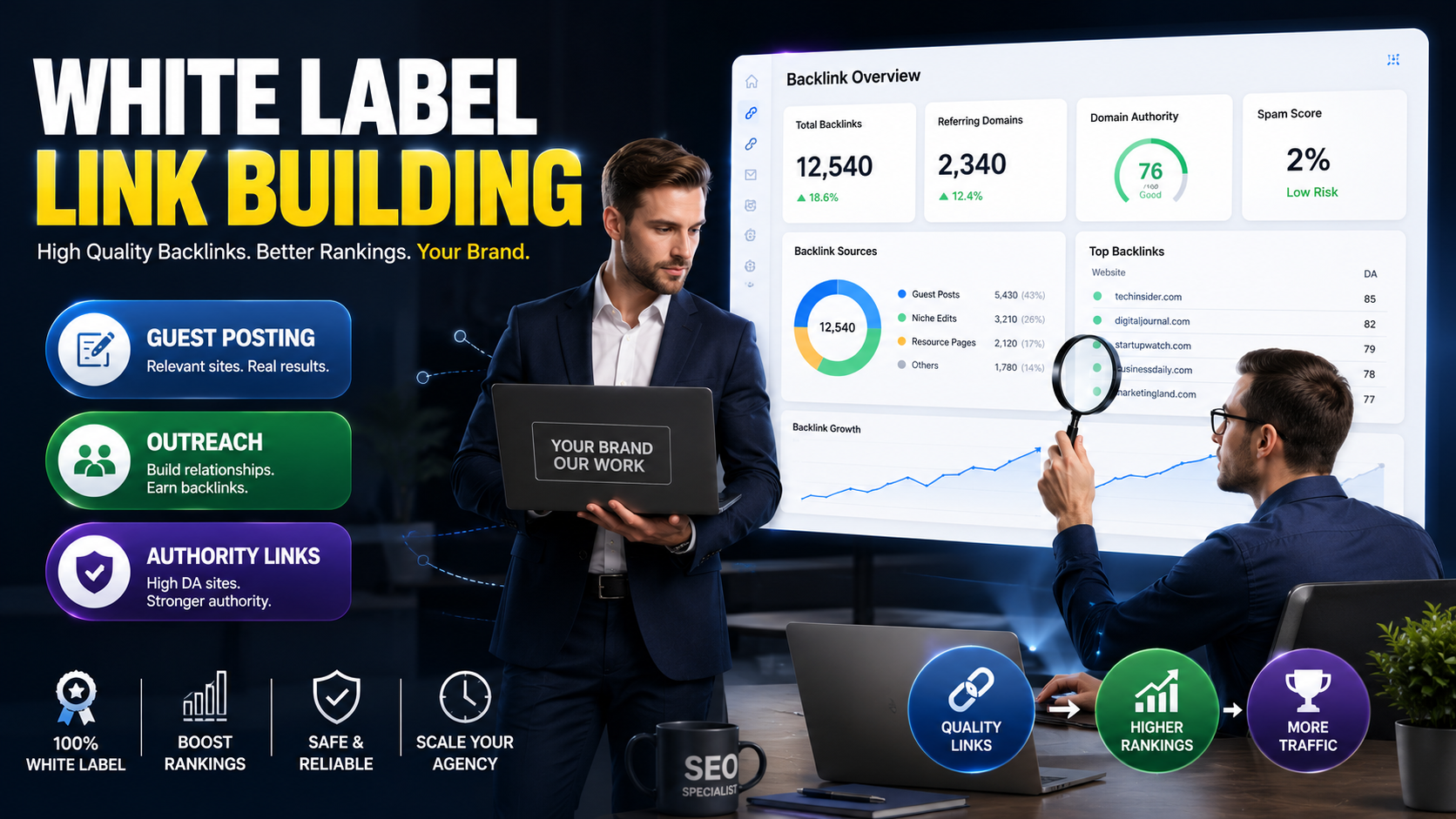
Link building is one of the toughest parts of SEO to deliver well. It takes time, real publisher contacts, and a team that knows how to land placements on sites that actually matter. Most agencies just don’t have room for all three. That’s where white label link building steps in. It lets your agency offer strong link building without hiring a single new person. A specialist team does the outreach and placement work behind the scenes. Your agency delivers the results under your own name. This guide breaks down what white label link building is, why agencies use it, and how to pick a provider you can trust.
What Does White Label Link Building Actually Mean?
White label link building is a setup where an outside team builds backlinks for you, but your client never knows it. You place the order, review the work, and send a branded report to your client. The client only ever sees your agency’s name on it.
The money side is simple too. You pay a wholesale rate to your provider, then charge your own clients whatever you decide. No hiring. No training. No building an outreach team from the ground up.
Here’s a quick look at how it fits together:
| Step | What Happens |
|---|---|
| 1. You order | You tell the provider what pages need links |
| 2. They build | The provider handles outreach and placement |
| 3. You review | You approve or reject each placement |
| 4. You report | You send a branded report to your client |
| 5. You get paid | You keep the difference between cost and price |
Agencies turn to this model because link building demands skills that many teams simply never had time to build. It fills a gap without slowing everything else down.
Why So Many Agencies Use White Label Link Building
Agencies aren’t picking this service by accident. It solves real problems that show up the moment client demand starts to grow.

It Cuts Costs Right Away
Hiring an in-house outreach team means paying for specialists, writers, and relationship managers every single month. That’s a big bill before a single link even goes live. White labeling skips all of that overhead.
It Grows Your Profit Margin
You set your own prices. Buy links at the provider’s rate, add your markup, and keep what’s left. Your client never needs to know what you paid.
It Gets You to Market Faster
Building publisher relationships in a brand new niche can take months. With this kind of setup, you plug into a network that already exists. You can start delivering links within weeks instead of quarters.
It Scales Without New Hires
Adding five new clients shouldn’t mean hiring five new staff members. Your provider absorbs the extra work while your team focuses on strategy and keeping clients happy.
It Keeps Quality Steady
A solid provider follows repeatable steps and runs quality checks on every placement. That means you get consistent results without managing daily execution yourself.
In-House Link Building vs. White Label Link Building
Should you build a team in-house or use a white label service instead? Here’s a side-by-side look to help you decide.
| Factor | In-House | White Label |
|---|---|---|
| Cost | High, needs full staff | Lower, pay per link or campaign |
| Speed | Months to build relationships | Weeks, network already exists |
| Control | Full control over every step | You approve, they execute |
| Scalability | Limited by team size | Grows with client demand |
| Risk | Depends on your team’s skill | Depends on picking the right partner |
Both paths work. In-house gives you tighter control over strategy. This model gives you speed and flexibility without the payroll. Most agencies choose based on how many active clients they’re juggling right now.
When White Label Link Building Makes the Most Sense
This service isn’t the right fit for every agency at every stage. It tends to work best in these situations:
- You’re handling three or more link building clients at once and starting to feel stretched thin.
- You’re entering a new niche where you don’t have any publisher contacts yet.
- You want to offer link building as a service but can’t justify hiring a full team.
- Your agency is growing faster than your team can keep up with.
- You need steady monthly output without missing deadlines.
If any of these sound familiar, it’s worth exploring what a white label partner could take off your plate.
Watch Out for Link Building Scams
Quality control is the biggest risk when you outsource. The kind of links a provider builds can make or break your client’s entire SEO campaign. Good links raise domain authority and improve rankings. Bad ones get ignored by Google, or worse, they trigger a penalty.
Here are common scams to avoid:
- PBNs. These are private networks of sites built purely to sell links.
- Link farms. Sites that exist only to host paid links, with no real audience.
- Directory and forum links. These rarely move the needle and can look spammy.
- Fake guest posts. Placed on low-value sites just to fill a quota.
- Unproven link builders. Providers who promise big results but can’t show past work.
A trustworthy provider will always be upfront about where your links come from.
If a provider hesitates to name real examples of their placements, treat that as a warning sign. Legitimate teams are proud to show off case studies and live URLs, because that proof is what sets them apart from the shortcuts everyone else is trying to sell.
How to Pick a White Label Link Building Provider
Not every provider is worth your trust. Here’s what to check before you sign up:
Pre-approval on placements. You should get to review every target site before outreach even starts. If a provider won’t allow this, that’s a red flag.
Real traffic, not just a high score. A site with a great domain rating but zero visitors isn’t worth much. Ask how the provider checks for actual readership.
Manual outreach only. Links built through genuine relationships hold up over time. Automated blasts and PBNs create risk instead.
A smart anchor text plan. Over-optimized anchor text can trigger a Google penalty fast. Your provider should map anchors to your client’s existing backlink profile.
Topical relevance. A smaller site in your client’s niche often beats a bigger site with no connection to the topic.
Clear, unbranded reporting. Every link should come with a live URL, target page, anchor text, and traffic data you can hand straight to your client.
A replacement guarantee. Strong providers will replace any link that drops within a set window, usually around 12 months.
What Types of Links Should a Provider Offer?
A strong white label link building partner won’t rely on just one tactic. Look for a mix of these:
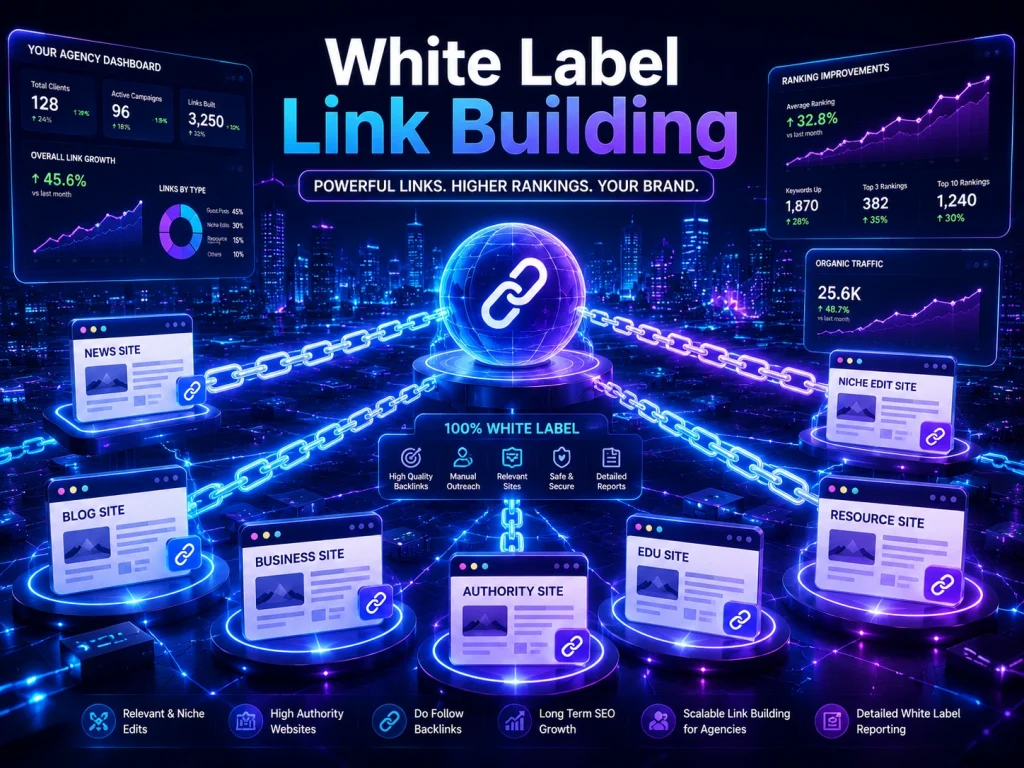
- Guest posts. Full articles published on relevant sites with a link back to your client.
- Editorial placements. Links added inside existing articles on trusted sites.
- Digital PR links. Coverage earned through newsworthy stories or expert quotes.
- HARO and journalist links. Your client gets quoted as an expert source in press coverage.
- Niche edits. Links added into older, already-indexed content on relevant pages.
The best campaigns blend several of these link types together. A provider who only offers one type probably can’t handle every client’s needs.
Think of it like a diversified investment portfolio. Relying on a single link type puts all your eggs in one basket, and if that channel loses value or gets flagged by Google, your client’s entire strategy takes the hit. Mixing formats spreads that risk out and builds a backlink profile that looks natural to search engines.
A Simple Six-Step Process for Building Links the Right Way
Most reliable providers follow a process that looks something like this:
- Order. You choose the link type and volume, and share which pages need links.
- Analysis. The provider studies your client’s site, competitors, and content.
- Strategy. A plan takes shape using tactics like guest posts and editorial links.
- Prospecting. The team builds a list of real sites and starts personalized outreach.
- Relationship building. Trust gets built with site owners to open up placements.
- Delivery. Links go live and get tracked, with reports sent your way.
This kind of structure keeps the whole process predictable, even when you’re managing several clients at once.
Frequently Asked Questions
Is link building still important for SEO?
Yes, backlinks remain one of the strongest ranking signals Google uses. Quality now matters far more than quantity. A handful of relevant, high-traffic links beats dozens of weak ones.
How long does it take to see results?
Most providers get the first links live within a month. The exact timeline depends on the niche and the editorial process of the target sites.
Can one provider handle multiple clients at the same time?
Yes, established providers manage many agency accounts at once. A solid team includes outreach specialists, writers, and strategists who split the workload smoothly.
What should I look for in a target site?
Check for real organic traffic, topical relevance, and original content. A site should also show a healthy balance of inbound and outbound links.
What’s the biggest risk with outsourcing link building?
Quality control. Some providers cut corners with low-value sites or automated outreach. Always vet a provider’s process before signing on.
Final Thoughts
This kind of partnership gives agencies a real shortcut. Instead of spending months building an outreach team from scratch, you tap into a network that already exists and start delivering results fast. You keep the client relationship and the credit, while a specialist handles the heavy lifting behind the scenes. Agencies that get this right treat their provider like an extension of their own team, not just a vendor. Regular check-ins, clear expectations, and honest feedback all make the partnership stronger over time. The agencies that struggle are usually the ones who set it and forget it, then wonder why quality slips.
The key is picking a provider you trust. Look for pre-approval on placements, real traffic data, and honest reporting. Do that, and this kind of partnership becomes one of the easiest ways to grow your agency’s SEO offering without growing your headcount.